
Description
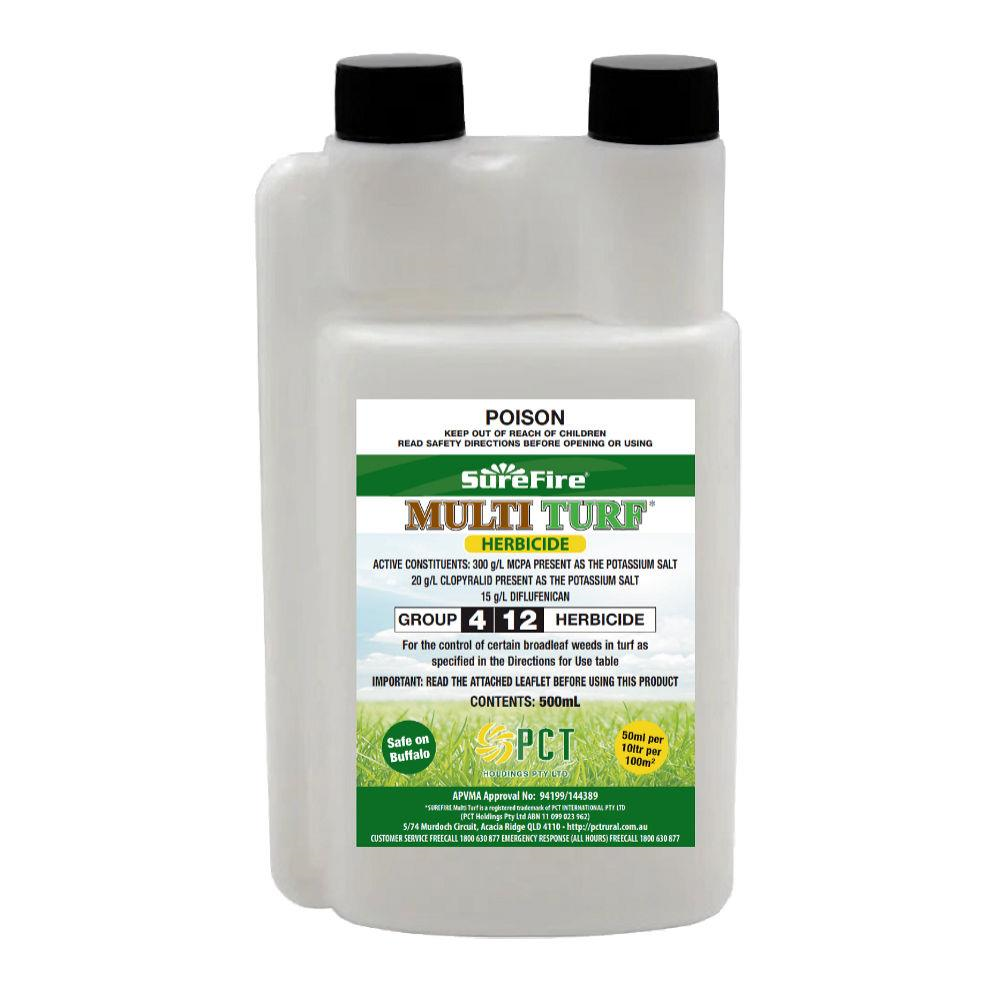
Surefire Multi Turf Herbicide delivers exceptional broadleaf weed control in turf through its powerful combination of three active ingredients – Diflufenican, MCPA, and Clopyralid. This strategic formulation utilises two distinct modes of action (Groups 4 and 12), working synergistically to achieve superior results at lower application rates than individual treatments.
Surefire Multi Turf Herbicide is compatible with warm—and cool-season grasses and can be applied throughout the year, offering turf managers outstanding flexibility in their weed management programs.
Active Ingredients: Diflufenican @ 15g/L, MCPA @ 300g/L and Clopyralid at 20g/L
What weeds does Surefire Multi Turf Herbicide control?
Broadleaf weeds, including;
White Clover (Trifoliumrepens)
Plantain (Plantago lanceolata)
Capeweed (Arctotheca calendula)
Cat’s Ear (Hypochaeris radicata)
Bin-dii (bindii, bindi, bindyi or bindi-eye) (Jo-Jo, Onehunga) (Soliva sessilis)
Bindii (and common misspellings: bindie, bindi), Bindy-eye (and common misspellings: bin-die, bindy-die), Carpet burweed, Common soliva, Field burweed, Field soliva, Jo jo, Jo jo weed, Sandbur, Lawn burrweed, Jo-jo weed/lawn burweed, Soliva, Onehunga weed)
Cudweed (Gnaphalium spp.)
Creeping Oxalis (Oxalis corniculata)
Where can Surefire Multi Turf Herbicide be used;
Surefire Multi Turf Herbicide can be used on most turf varieties, including Buffalo*.
Transient discolouration may occur on Kikuyu, Carpet grass and Queensland Blue Couch.
*Varietal differences in certain Buffalo grasses (e.g. ST85) may produce more pronounced effects, and therefore, it is recommended that small areas be tested for turf safety before large-scale application occurs.
It should not be used on bentgrass or winter grass golf and bowling greens.
How do you get the best results from Surefire Multi Turf Herbicide;
Avoid exceeding application rates through overlapping sprayed areas.
Use a surfactant for difficult-to-wet weeds.
For best results, the turf and weeds should be actively growing at the time of treatment.
Complete weed death may take up to 6 weeks.
Faster results can be expected on smaller weeds.
Due to residual effects on diflufenican, overseeding treated areas within 3 months of application may inhibit the establishment of the turf grass.


